
The wait
Before thrombolysis, clinicians need to know how much DOAC is still in the blood.
"DOAC levels are the only thing we wait for currently before thrombolysis."Neurologist, interviewed by MedicQuant
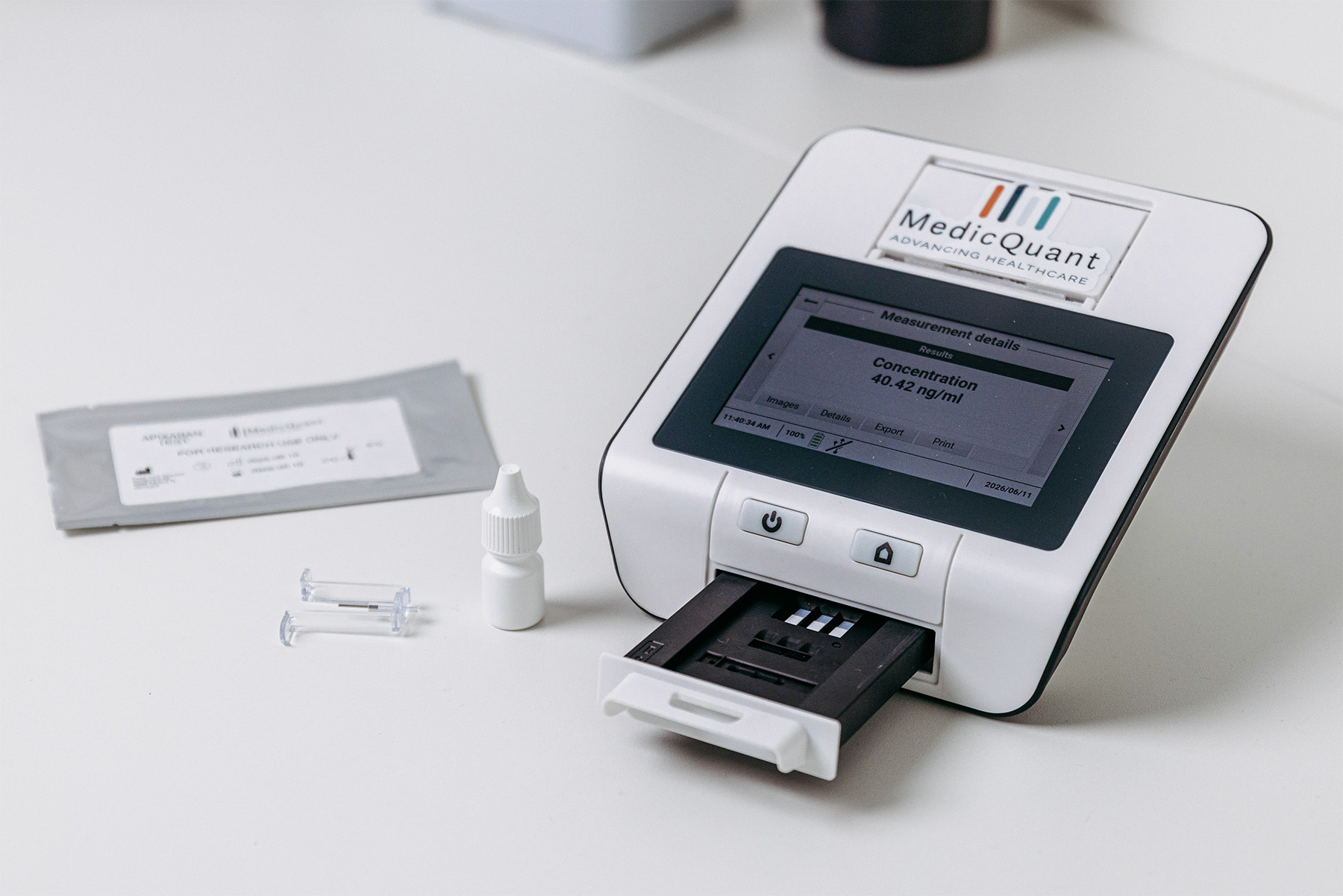
A quantitative DOAC level from whole blood in 10 minutes, measured at the bedside, while the stroke team decides.
Follow one testPeer reviewed in ACS Sensors, July 2026. Read the paper
Scroll through a single measurement. The cartridge on the left does what the text on the right describes.
No centrifuge and no plasma preparation. The sample goes straight from the patient into a single disposable cartridge.
A blood separation filter holds back the red cells. Plasma moves on along a glass fibre strip by capillary action alone.
An antibody-DNA conjugate and an analyte-DNA strand. If the anticoagulant is in the sample, it competes for the antibody and changes how the DNA labels sit together.
It excites the Cy3 dye and measures emission from Cy3 and Cy5. With no drug present, energy transfers (FRET). With drug present, it does not. The ratio is the measurement.
The screen shows a quantitative DOAC concentration, with accuracy comparable to laboratory standards. The thrombolysis decision no longer waits for the central lab.
Intermediate timings are illustrative. Total time to result, as stated by MedicQuant: 10 minutes.
Patients on direct oral anticoagulants arrive with a question nobody can answer at the bedside today. MedicQuant was built around that wait.
Before thrombolysis, clinicians need to know how much DOAC is still in the blood.
"DOAC levels are the only thing we wait for currently before thrombolysis."Neurologist, interviewed by MedicQuant
A quantitative level, comparable to laboratory standards, on the reader next to the patient.
Designed for emergency staff, not lab specialists. Users at relevant sites rated the system easy or very easy.
The cartridge and reader are built on patent-pending DNA nanotechnology. Anticoagulants come first. The same principle has been shown for other drug classes.



Led by CEO Line Debois Frejlev Nielsen and CTO Malthe Hansen-Bruhn, with hardware, quality and regulatory in house.
Meet the teamSelected for the EIC Accelerator in 2026, with public and private investors behind us. We are looking for new investors to join existing ones on the way to market.